Test Report
PFX Flex™ Sub-Lite-Wall™
Comparing PFX Flex™ vs. PTFE Catheter Liners
For the last several decades, PTFE has been the preferred material for engineers developing advanced vascular and non-vascular catheters. Its blend of highly desired properties, including its high lubricity and flexibility, as well as its ability to be manufactured into extremely thin-walled tubing with tight dimensional control, has enabled the development of many of today’s most advanced devices and transformative therapies – achievements that would otherwise have been unattainable.
While PTFE’s unique molecular makeup gives it many of its highly sought-after properties, it also results in some nuances that engineers must consider when developing devices. For instance, PTFE’s strong carbon-fluorine (C-F) bonds prevent it from readily bonding with other materials, presenting a challenge for catheter manufacturers who must bond overlying jacketing materials to PTFE catheter liners. Similarly, PTFE’s carbon-carbon (C-C) backbone makes it a poor candidate for gamma or e-beam sterilization protocols, limiting most PTFE-based devices to just EtO sterilization.
These factors, combined with potential PFAS regulations and a growing number of sustainability initiatives, have led to increased demand for an alternative material that offers comparable performance to PTFE while also offering new advantages. After years of painstaking research and development, we are proud to finally introduce such a material: PFX Flex™.
Engineered as an alternative to film-cast PTFE, PFX Flex™ Sub-Lite-Wall™ is a next-gen catheter liner that delivers proven lubricity, enhanced bond strength, and expanded sterilization options – all without PFAS.1
To evaluate our new PFX Flex Sub-Lite-Wall liners, we performed a series of tests to compare performance to that of PTFE liners. We examined physical properties, including lubricity and flexibility, as well as bond strength, performance after sterilization, and particulate generation. While the full test report can be downloaded here, I’m excited to share a few highlights from the report below.
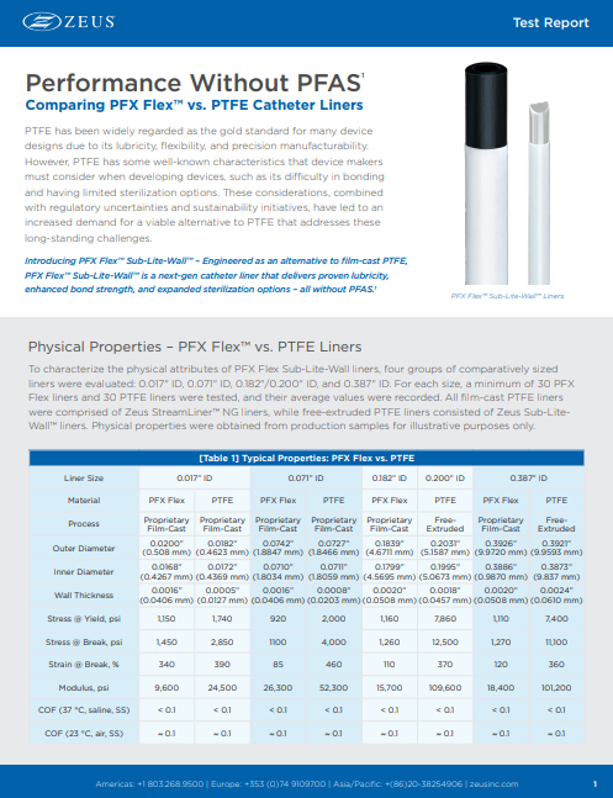
The lubricity of a liner plays a crucial role in catheter design, particularly when devices such as implants or balloons need to travel efficiently through the catheter’s central lumen. A lower-friction liner minimizes the force required to advance and deploy these devices, helping to support more consistent and reliable performance. Our testing revealed the coefficient of friction (COF) for PFX Flex to be around 0.1 at 23 °C in air, and less than 0.1 at 37 °C in saline, the latter simulating use within the body. With a COF of ~ 0.1 or lower, these results indicate that PFX Flex is an extremely lubricious material, comparable to PTFE, and unlike other solutions on the market, PFX Flex exhibits this excellent lubricity without the use of additives or coatings.
The flexibility of a catheter is a crucial factor in determining the device’s performance when navigating tortuous pathways within the body. While today’s advanced catheter designs incorporate multiple material layers in their construction, the catheter liner itself plays a tremendous role in dictating the overall flexibility characteristics of the completed device. Our testing revealed that catheter shafts lined with free-extruded PTFE Sub-Lite-Wall™ were about 20% stiffer than those lined with PFX Flex, while catheter shafts lined with PFX Flex were just as flexible as those lined with film-cast PTFE StreamLiner™ NG, despite the film-cast PTFE liners having significantly thinner walls.
Medical devices intended for use in the human body must undergo sterilization prior to use. Several sterilization methods are available for such devices, including electron beam (e-beam), gamma, and ethylene oxide (EtO). However, because of PTFE’s susceptibility to radiation-induced degradation, devices containing PTFE cannot be sterilized by e-beam or gamma irradiation. In our testing, we saw that catheter shafts lined with PFX Flex Sub-Lite-Wall liners exhibited no significant impact on performance post-sterilization, regardless of whether EtO, e-beam, or gamma was used.
While PTFE has long set performance expectations in medical device applications and will remain a critically important material for decades to come, the next generation of innovation must strike a balance between high performance and greater responsibility. We believe that PFX Flex is more than just a materials science breakthrough; it’s a strategic advantage that supports sustainability and compliance without compromise, while delivering performance without PFAS.1
To view the full test report on PFX Flex™ vs. PTFE Catheter Liners, click here.
1. PFX Flex™ Sub-Lite-Wall™ liners are made using a non-fluorinated polymer resin alternative to PTFE and without the intentional addition of any per- or polyfluoroalkyl substances (PFAS). Independent third-party laboratory analysis on representative samples of PFX Flex™ Sub-Lite-Wall™ liners has confirmed total fluorine levels of less than 20 ppm in liner samples analyzed.